Wisdom of the Rishis: The Three Upanishads: Ishavasya, Kena & Mandukya by Sri M
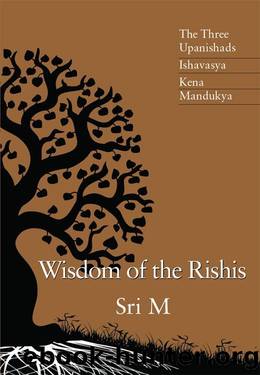
Author:Sri M [M, Sri]
Language: eng
Format: epub
Tags: Spiritual
ISBN: 9788191009637
Publisher: Magenta Press
Published: 2012-02-25T18:30:00+00:00
he Upanishads form part of the Vedas. When we talk about the Vedas, it is generally the Samhita portions; Samhita, meaning, âthe hymnsâ of the Vedas, which are the Rig Veda, the Yajur Veda, the Sama Veda and the Atharvana Veda. These are the four important Vedas that have been handed down to us from time immemorial. In fact, no one can say where they originated or how they came to us. They are known as shruti because it is said that they were âheard.â Shruti means âthrough the ear.â Shruti was heard by the wise rishis of ancient times who passed down the body of wisdom that takes us to the essence of all life and provides the answers to questions like â What is God? What is the human being? How is human life connected to God? And so on and so forth.
The last portion of the Vedas is a section that is known as the Jnana Kanda, which means âthe Wisdom Section.â This is the section where the Upanishads come in. So they are basically discussions on the truths which have been given in the shruti. The Upanishads themselves are considered to be shruti. They bring us to an understanding, first theoretically and then actually, of what we call the âSupreme Being,â Brahman or Atman or Ishwara.
Now, the meaning of the word âUpanishadâ â Upa means âto move closer,â âto go nearerâ and shad means âto sit downâ physically and also to settle down the mind. Two interpretations have been given: The first is, âto sit in front of the teacher.â You can imagine the situation in ancient times where there would be a beautiful hermitage on the banks of a river beside the mountains, where the great rishi taught his students who sat around him. The students did not sit far away, so there was always a personal contact with the students. These are matters where personal contact is very important. So, the teacher and the students sat down close to each other, and the students listened to the truths that were being expounded by the teacher.
There is the syllable ni that connects upa and shad. Ni indicates the level at which the person who âreceivesâ sits â a little âlowerâ than the teacher. It does not mean the physical level. It indicates a psychological state of mind, where the disciple or the seeker acknowledges that he does not know. He supposes that his teacher, the rishi, knows, and therefore he sits down with humility. This is the meaning of ni â âto sit down at a lower level with great humility.â He sits down and listens to the teacher propounding the truths of the shruti and explaining them. This is the meaning of âUpanishad.â
When you say shad, âto sit,â it means not only to physically sit down but it also means âthe settling down of the mindâ which normally is attracted by all the activities of the material world and runs hither and thither like a monkey all the time.
Download
This site does not store any files on its server. We only index and link to content provided by other sites. Please contact the content providers to delete copyright contents if any and email us, we'll remove relevant links or contents immediately.
| Anthropology | Archaeology |
| Philosophy | Politics & Government |
| Social Sciences | Sociology |
| Women's Studies |
The remains of the day by Kazuo Ishiguro(9112)
Tools of Titans by Timothy Ferriss(8519)
Giovanni's Room by James Baldwin(7462)
The Black Swan by Nassim Nicholas Taleb(7218)
Inner Engineering: A Yogi's Guide to Joy by Sadhguru(6847)
The Way of Zen by Alan W. Watts(6689)
The Power of Now: A Guide to Spiritual Enlightenment by Eckhart Tolle(5874)
Asking the Right Questions: A Guide to Critical Thinking by M. Neil Browne & Stuart M. Keeley(5852)
The Six Wives Of Henry VIII (WOMEN IN HISTORY) by Fraser Antonia(5569)
Astrophysics for People in a Hurry by Neil DeGrasse Tyson(5241)
Housekeeping by Marilynne Robinson(4520)
Double Down (Diary of a Wimpy Kid Book 11) by Jeff Kinney(4354)
12 Rules for Life by Jordan B. Peterson(4351)
Ikigai by Héctor García & Francesc Miralles(4335)
Skin in the Game by Nassim Nicholas Taleb(4324)
The Ethical Slut by Janet W. Hardy(4315)
The Art of Happiness by The Dalai Lama(4184)
Skin in the Game: Hidden Asymmetries in Daily Life by Nassim Nicholas Taleb(4069)
Walking by Henry David Thoreau(4029)
